CONTINENTAL CONTROLS CORPORATION 67100008 Oxygen Sensor OSI-5 Interface
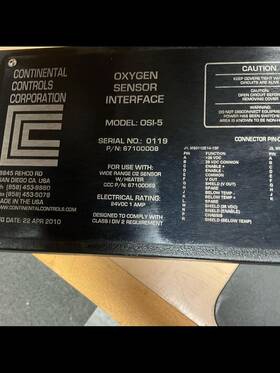
( Brand: Continental Controls Corporation ), ( Manufacturer Part Number: 67100008 ), ( Model: OSI-5 ), ( Type: Compressor Parts And Components )
Review CONTINENTAL CONTROLS CORPORATION Oxygen Sensor Interface Pn Model
The **Continental 67100008 Oxygen Sensor Interface (OSI-5)** is a high-performance, precision-engineered component designed to facilitate seamless communication between oxygen sensors and modern vehicle diagnostic systems, ensuring optimal exhaust gas monitoring and emission control. Part of Continental s advanced automotive diagnostics lineup, this interface module is specifically tailored for applications requiring robust signal processing, enhanced reliability, and compliance with stringent OBD-II (On-Board Diagnostics) and EOBD (European On-Board Diagnostics) standards. Built with a focus on durability and precision, the OSI-5 interfaces directly with lambda (O ) sensors, converting raw analog signals into digital data that can be accurately read by vehicle control units (ECUs) or diagnostic tools, thereby enabling precise air-fuel ratio adjustments and fault detection.
At its core, the OSI-5 leverages Continental s proprietary signal conditioning technology to mitigate interference, noise, and voltage fluctuations, ensuring clean and consistent data transmission even under harsh operating conditions. Its compact yet robust design incorporates high-quality connectors and shielding to protect against electromagnetic interference (EMI) and environmental stressors such as moisture, dust, and temperature extremes, making it ideal for integration into both passenger vehicles and commercial applications. The module s modular architecture allows for easy installation and replacement, reducing downtime and maintenance costs while maintaining compatibility with a wide range of sensor types, including wide-band and narrow-band lambda probes.
Beyond its technical robustness, the OSI-5 is engineered with future-proofing in mind, supporting advanced diagnostic protocols such as ISO 9141, ISO 14230, and SAE J1850, which are critical for meeting evolving emissions regulations and diagnostic requirements. Whether deployed in aftermarket diagnostic tools, original equipment manufacturer (OEM) systems, or specialized testing equipment, this interface ensures that oxygen sensor data is transmitted with unparalleled accuracy, enabling engineers and technicians to diagnose engine performance issues, optimize fuel efficiency, and comply with regulatory standards. With its blend of precision engineering, reliability, and adaptability, the Continental 67100008 OSI-5 stands as an indispensable component for anyone seeking to enhance the diagnostic capabilities of their automotive systems.
### **Pros and Cons of buying a Continental 67100008 Oxygen Sensor Interface (OSI-5)**
#### **Pros:**1. **Compatibility with Continental O2 Sensors** This interface is specifically designed to work with Continental s OE (Original Equipment) and aftermarket oxygen sensors, ensuring proper signal transmission to the vehicle s ECU (Engine Control Unit).
2. **Improved Sensor Functionality** The OSI-5 module helps maintain accurate oxygen sensor readings, which are critical for optimal fuel mixture, emissions control, and engine performance, especially in modern vehicles with closed-loop fuel systems.
3. **Diagnostic Capabilities** Some versions of this interface may support diagnostic functions, allowing mechanics to read sensor data directly, which can help in troubleshooting misfires, poor fuel economy, or check engine lights related to O2 sensor issues.
4. **Compatibility with Aftermarket Sensors** If you are replacing a faulty OE sensor with an aftermarket one, this interface ensures the new sensor integrates correctly with the vehicle s ECU, preventing misdiagnoses or performance issues.
5. **Potential Cost Savings** In some cases, using this interface instead of a full sensor replacement (if the original sensor is still functional but the wiring or connector is damaged) can reduce repair costs.
6. **Widely Available and Standardized** Continental is a major automotive supplier, and this interface is a common OE part, meaning it is easy to source and install.
---
#### **Cons:**1. **Limited to Continental Sensors** This interface is not universal; it will only work with Continental-branded oxygen sensors. If your vehicle uses Bosch, Denso, or another brand s sensor, this part will not be compatible.
2. **Potential Overkill for Simple Issues** If the problem is not related to the sensor interface (e.g., a faulty wiring harness, ECU issue, or vacuum leak), replacing or installing this interface may not resolve the underlying problem.
3. **Cost Consideration** While this part is not extremely expensive, if the original sensor is still functional, replacing just the interface may not be the most cost-effective solution. A full sensor replacement might be necessary if the sensor itself is faulty.
4. **Installation Complexity** Depending on the vehicle s wiring layout, installing or replacing this interface may require some disassembly, especially if it is part of a sensor harness assembly. Improper installation could lead to loose connections or damage.
5. **Compatibility with Modern ECUs** Some newer vehicles with advanced diagnostic systems (e.g., OBD-II with expanded fault codes) may require additional programming or calibration when replacing sensor interfaces, though this is less common with OE parts like Continental s.
6. **Risk of Counterfeit Parts** As with any aftermarket or OE replacement part, there is a chance of purchasing a counterfeit or low-quality version, which could fail prematurely or not function as intended.
---
### **Conclusion:**The **Continental 67100008 Oxygen Sensor Interface (OSI-5)** is a reliable and necessary component for vehicles that require a Continental-branded oxygen sensor interface, particularly in cases where the original interface is damaged or the sensor needs to be replaced with a Continental-compatible unit. It ensures proper sensor communication with the ECU, which is essential for accurate fuel delivery and emissions control.
However, it is not a universal fix it only works with Continental sensors, and its usefulness depends on whether the issue is indeed related to the interface rather than the sensor itself or other system components. If the oxygen sensor is faulty, replacing just the interface may not resolve the problem, and a full sensor replacement might still be needed.
### **Recommendation:** - **Buy this part if:**- You are replacing a Continental oxygen sensor and need the correct interface for proper ECU communication.
- Your vehicle s diagnostic trouble codes (DTCs) point specifically to an interface or wiring issue with a Continental sensor.
- You are confident that the sensor itself is functional, and only the interface is damaged.
- **Avoid or reconsider if:**- The oxygen sensor itself is faulty (a full sensor replacement may be required).
- You are unsure whether the issue is with the interface, sensor, or another component (diagnostic testing is recommended first).
- You are working on a non-Continental sensor system (this interface will not work).
- The cost of the interface alone does not justify the repair (e.g., if the sensor is also bad).
**Final Advice:** Always verify the exact issue with a diagnostic scan before purchasing this part. If possible, consult a professional mechanic to confirm whether the interface or the sensor itself needs replacement. Purchasing from a trusted supplier (e.g., an authorized Continental dealer or a reputable automotive parts store) will help ensure you get a genuine, high-quality part.
Details:
Continental Controls corporation Oxygen Sensor Interface PN 67100008 model OSI-5.
part #: 67100008 price
- $500.00
specifications motohva:
- brand: Continental Controls Corporation
- mpn: 67100008
- model: Osi-5
- type: Compressor Parts And Components
general motohva:
- condition: Used
- HVAC Refrigeration > HVAC Refrigeration Components > Compressors
offer motohva:
- started: May 5, 2026
- availability: In Stock
- quantity: 1
- sold: 0
- best offers: True
- options: Ship-to-home
shipping motohva:
- service: UPS Ground
- transit: 3-7 Days
- cost: $23.31
- class: Standard
- carrier: UPS
- type: Calculated
seller motohva:
- rating: 98.6%
- city: Valencia, California
- # reviews: 129
payments motohva:
- other
- credit card: Discover
- wallet: Paypal
returns motohva:
- policy: Returns Accepted
- paid by: Buyer
- method: Money back
- time: 14 Days